
The Whooping Crane: A Portrait of Resilience
There is something unmistakably arresting about the whooping crane—North America’s tallest bird, with luminous white plumage, a bold red crown, and a gaze that feels almost prehistoric. It carries itself with a calm authority, a presence shaped by long migrations and centuries of survival.
When I set out to paint this crane, I wasn’t drawn to motion or drama. Instead, I wanted to capture stillness—the kind of stillness that speaks to endurance.
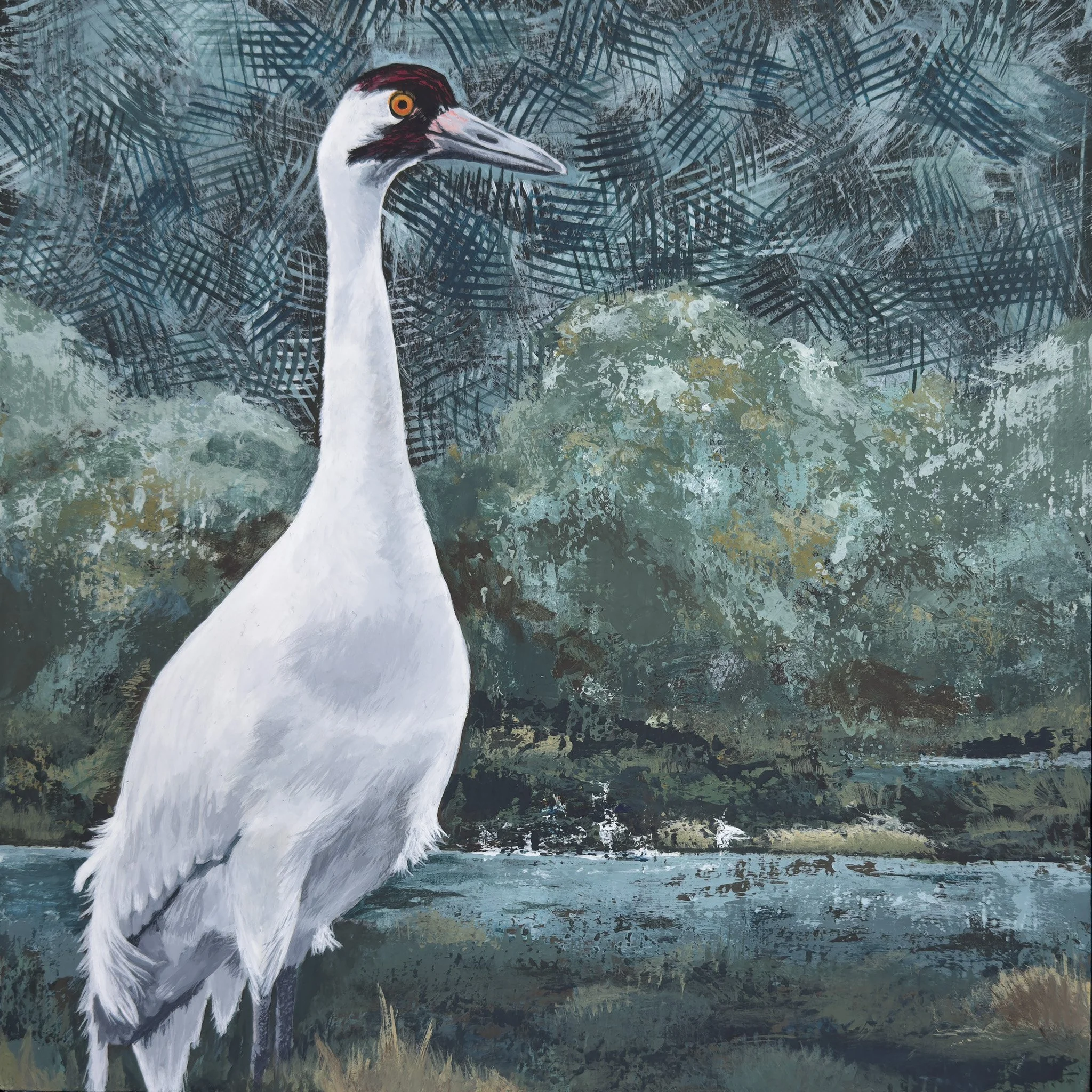
“Marshland Monarch” 12 x 12 Acrylic on wood panel
This is part of my latest collection. I’m really drawn to this bird and its piercing gaze.
A Cultural Symbol of the Wetlands
For generations, the whooping crane has held cultural significance for Indigenous peoples of North America, often symbolizing longevity, balance, and fidelity. Its distinctive call—resonant and far-carrying—made it more than a bird to be seen; it was a presence to be heard across the wetlands, a reminder of seasonal rhythms and living landscapes (U.S. Fish & Wildlife Service, n.d.).
In the modern era, the whooping crane has taken on an additional meaning. By the 1940s, habitat loss and unregulated hunting reduced the global population to fewer than 25 birds, making the species one of the most endangered in North America (IUCN, 2023). Since then, it has become a powerful symbol of conservation—both a warning and a source of hope.
Where Whooping Cranes Live
Whooping cranes are found only in North America, and their life cycle is defined by one of the continent’s most remarkable migration routes.
They breed primarily in and around Wood Buffalo National Park in northern Canada during the spring and summer months (USGS, n.d.). In fall and spring, they migrate through the Great Plains, relying on rivers, wetlands, and open agricultural fields as vital stopover habitat (U.S. Fish & Wildlife Service, n.d.). Many members of the wild migratory population spend the winter along the Texas Gulf Coast, particularly at Aransas National Wildlife Refuge and nearby coastal marshes (USGS, n.d.).
In addition to this primary migratory population, conservation programs have worked to establish other groups through reintroduction efforts in places such as Wisconsin and Louisiana, with varying levels of success (U.S. Fish & Wildlife Service, n.d.).
Conservation Status: Fragile Progress
Despite decades of recovery efforts, the whooping crane remains listed as Endangered under the U.S. Endangered Species Act and as Endangered on the IUCN Red List (U.S. Fish & Wildlife Service, n.d.; IUCN, 2023). However, there are encouraging signs.
During the winter of 2024–2025, surveys documented at least 557 whooping cranes wintering along the Texas coast, including 41 juveniles, marking one of the highest counts recorded for the species (U.S. Fish & Wildlife Service, 2025). While this represents meaningful progress, habitat loss, water availability, and climate-related pressures continue to pose significant challenges to long-term recovery.
Painting a Survivor
As I worked on this painting, I kept returning to the idea of presence—not as stillness without movement, but as balance held in quiet tension. The crane stands alert and composed, its gaze directed beyond the frame, as though aware of both past and future.
The background is intentionally layered and textured rather than literal. It suggests wetlands shaped by water, wind, and time—places marked by migration routes and memory rather than boundaries on a map. I wanted the environment to feel alive, but unsettled, reflecting the reality that the whooping crane’s survival remains closely tied to fragile landscapes.
Painting this bird felt less like documentation and more like acknowledgment.
Why the Whooping Crane Matters
The story of the whooping crane is inseparable from the story of wetlands themselves—ecosystems that filter water, support biodiversity, buffer storms, and sustain countless species. Protecting the crane means protecting these essential habitats and the interconnected life they support.
For me, painting the whooping crane is both an act of admiration and an invitation: to look closely, to consider what endures, and to recognize the quiet resilience that exists at the edges of our shared world.
References
International Union for Conservation of Nature (IUCN). (2023). Grus americana (Whooping Crane). IUCN Red List of Threatened Species. https://www.iucnredlist.org/species/22692090/181242855
U.S. Fish & Wildlife Service. (n.d.). Whooping Crane (Grus americana) Species Profile. https://www.fws.gov/species/whooping-crane-grus-americana
U.S. Fish & Wildlife Service. (2025). Wintering Whooping Crane Count Press Release. https://www.fws.gov/press-release/2025-06/2025-wintering-whooping-crane-count
U.S. Geological Survey (USGS). (n.d.). Migration and Winter Ecology of the Aransas–Wood Buffalo Population. https://www.usgs.gov/centers/northern-prairie-wildlife-research-center/science/migration-and-winter-ecology-aransas-wood