
Painted Bunting: Art, Conservation, and a Changing Coastal Landscape
There are few birds in North America that feel as improbable as the painted bunting. With its vivid blues, greens, yellows, and reds, it almost looks imagined—like something lifted from a painter’s palette rather than a woodland edge or coastal thicket. And yet, it exists quietly, often hidden in dense brush, its brilliance revealed only to those patient enough to notice.
When I began painting this bird, I wasn’t trying to capture spectacle. I was drawn instead to contrast—the tension between its extraordinary color and the quiet, often overlooked habitats it depends on.
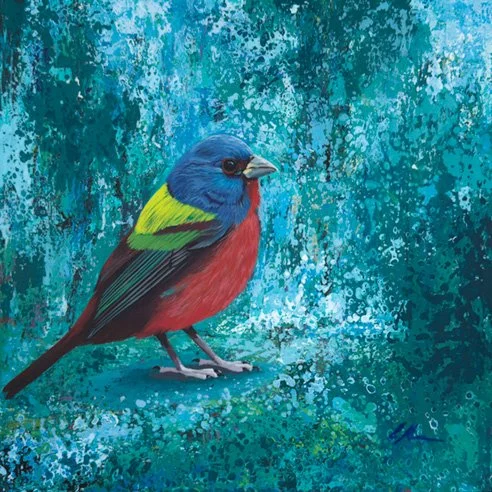
“Unparalleled” 12 x 12 Acrylic on wood panel
This piece is part of my latest collection. I kept coming back to the intensity of its color against a textured, almost abstract background—something that feels both vibrant and uncertain.
A Living Work of Color
The painted bunting (Passerina ciris) is often described as one of North America’s most beautiful birds (Nonparielle , and for good reason. Adult males display a striking combination of deep blue, bright green, and red plumage, while females and juveniles remain a softer green—subtle, camouflaged, and equally adapted to their surroundings (Cornell Lab of Ornithology, n.d.).
But beyond its appearance, the bunting is also known for its song—a series of clear, musical notes that carry through thickets and woodland edges during breeding season. It’s a bird more often heard than seen, its presence revealed in fragments rather than full view (Audubon Society, n.d.).
Where Painted Buntings Live
Painted buntings are found primarily in the southeastern and south-central United States, though their range is divided into two distinct populations.
The eastern population breeds along the coastal Southeast, particularly in states like North Carolina, South Carolina, Georgia, and Florida. These birds favor maritime forests, shrubby edges, and coastal habitats where dense vegetation provides both cover and nesting sites (Audubon Society, n.d.).
The western population is found in parts of Texas, Oklahoma, Arkansas, and Louisiana, where they inhabit brushy areas, woodland edges, and riparian corridors. Unlike their eastern counterparts, many of these birds migrate south into Mexico and Central America for the winter (Cornell Lab of Ornithology, n.d.).
Across both populations, one thing remains consistent: painted buntings rely on habitats that are often transitional—places between forest and field, wild and developed. These are landscapes that are easily altered or lost.
Conservation Status: Beauty at Risk
In addition to these ongoing pressures, recent land-use decisions along the Texas coast have raised serious concerns among conservationists. State and federal actions supporting land swaps and expansion tied to the SpaceX Starbase facility at Boca Chica have already altered portions of protected coastal habitat, with additional exchanges involving wildlife refuge acreage under consideration (Texas Tribune, 2024; Courthouse News, 2026). These landscapes are not incidental—they are part of a critical migratory corridor used by countless species, including painted buntings and whooping cranes, whose survival depends on intact coastal ecosystems (Defenders of Wildlife, 2024).
Conservation organizations warn that continued industrial expansion in this region risks accelerating habitat fragmentation at a scale that is difficult to reverse. The American Bird Conservancy has been actively working to challenge and limit these impacts while advocating for stronger protections. If you feel compelled to support the preservation of these vital habitats, you can learn more and take action here:
https://www.nytimes.com/2025/12/23/climate/spacex-land-exchange-texas.html
https://abcbirds.org/news/spacex-destroys-habitat/
https://travisaudubon.org/murmurations/protect-texas-wildlands-from-spacex
Painting Color and Uncertainty
As I worked on this painting, I kept returning to the idea of contrast—not just in color, but in context. The bird itself is vivid, almost luminous, while the background is layered and textured, suggesting a landscape that is shifting, unstable, or in flux. I didn’t want a literal setting. Instead, I wanted to evoke a sense of place that feels alive but unresolved—something that reflects the fragile environments this species depends on.
There’s a quietness to the bunting’s posture, but also an alertness. It feels present, aware, as though existing in a space that is both beautiful and uncertain. Painting it became less about capturing likeness and more about holding that tension.
Why the Painted Bunting Matters
The painted bunting is a reminder that not all beauty is loud or easily seen. It exists in the margins—hidden in brush, revealed in glimpses, sustained by habitats that are often undervalued.
Protecting this species means recognizing the importance of those in-between places: coastal thickets, overgrown edges, and transitional landscapes that support not just buntings, but a wide range of wildlife.
For me, painting the painted bunting is an act of attention. It’s a way of slowing down, of noticing what might otherwise be overlooked, and of honoring the quiet brilliance that still exists within our changing world.
References
Audubon Society. (n.d.). Painted Bunting (Passerina ciris). National Audubon Society. https://www.audubon.org/field-guide/bird/painted-bunting
Cornell Lab of Ornithology. (n.d.). Painted Bunting Overview. All About Birds. https://www.allaboutbirds.org/guide/Painted_Bunting
International Union for Conservation of Nature (IUCN). (2023). Passerina ciris (Painted Bunting). IUCN Red List of Threatened Species. https://www.iucnredlist.org/species/22724045
U.S. Fish & Wildlife Service. (n.d.). Painted Bunting Conservation and Habitat Information.https://www.fws.gov
Texas Tribune. (2024). SpaceX land swap at Boca Chica State Park. (The Texas Tribune)
Courthouse News. (2026). Proposed wildlife refuge land exchange with SpaceX. (courthousenews.com)
Defenders of Wildlife. (2024). Ecological importance of Boca Chica region for migratory species. (Defenders of Wildlife)
American Bird Conservancy. (n.d.). SpaceX and coastal habitat conservation efforts. (American Bird Conservancy)
*A Note on How This Post Was Made
I sometimes team up with AI tools to help shape my blog posts—kind of like having a brainstorming buddy who never runs out of ideas. I always review, edit, and add my own touch, so everything you read here still comes straight from my love of art, nature, and birds.